Oxfam calls for troops in Africa as criticism of ‘inadequate’ Ebola response mounts
Anger is growing over the “inadequate” response to the Ebola
epidemic this weekend with the World Health Organisation’s Africa office
accused of incompetence and world governments of having failed.
Aid charities and the president of the World Bank are among the
critics, declaring that the fight against the virus is in danger of
being lost.
On Saturday Oxfam took the unusual step of calling for troops to be
sent to west Africa, along with funding and medical staff, to prevent
the Ebola outbreak becoming the “definitive humanitarian disaster of our
generation”. It accused countries that did not commit military
personnel of “costing lives”.
The charity said that there was less than a two-month window to curb
the spread of the virus but there remained a crippling shortfall in
logistical support.
Several African countries have for the last decade been suffering
severe shortages of homegrown medics thanks to a “brain drain” to
countries such as Britain, which rely on foreign workers.
The executive director of frontline medical charity Médecins Sans
Frontières, Vickie Hawkins, said national and global health systems had
failed. “We are angry that the global response to this outbreak has been
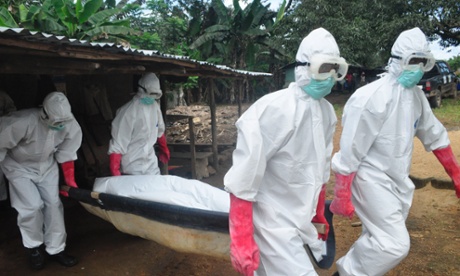
so slow and inadequate. A burial team in protective gear carry the body of woman suspected to have died from Ebola in Monrovia, Liberia.
“We have been amazed that for months the burden of the response
could be carried by one single, private medical organisation, while
pleading for more help and watching the situation get worse and worse.
When the outbreak is under control, we must reflect on how health
systems can have failed quite so badly. But the priority for now must
remain the urgent fight against Ebola – we simply cannot afford to
fail.”
The worst outbreak on record has claimed 4,500 lives, out of 8,914
recorded cases since the start of the year, mostly in Liberia, Sierra
Leone and Guinea. The true number is agreed to be higher. There are some
3,700 Ebola orphans.
The WHO has said that the worst case scenario was the infection rate
reaching 10,000 a week by December but the agency is under heavy fire
over a leaked internal report pointing to serious bungling of the
epidemic. The WHO, the UN agency designated with coordinating
international response to disease outbreaks, missed chances to prevent
Ebola from spreading when it was first diagnosed last spring, thanks to
incompetent staff, a lack of information and bureaucracy due to
“politically motivated appointments”, the report says. “Nearly everyone
involved in the response failed to see some fairly plain writing on the
wall,” said the report, obtained by the Associated Press. “A perfect
storm was brewing.” The WHO refused to comment on the draft report.
Dr Peter Piot, co-discoverer of the Ebola virus,
said WHO acted too slowly. “It’s the regional office in Africa that’s
the front line,” said Piot. “And they didn’t do anything. That office is
really not competent.”
On Monday EU foreign ministers are due to meet in Brussels and David
Cameron has called for fellow European leaders to double their
contribution to the Ebola fighting fund. The UK has committed £125m –
the second highest sum after the US although aid agencies say help is
still not reaching the ground – as well as 750 troops. Cameron is
calling for a €1bn (£800m) EU pledge.
President Barack Obama on Saturday urged Americans to avoid hysteria
over Ebola, and played down the idea of travel bans from Ebola-ravaged
countries in west Africa. “We can’t cut ourselves off from west Africa,”
Obama said, adding that it would make it harder to move health workers
into the region, and would motivate people trying to get out of the
region to evade screening. “Trying to seal off an entire region of the
world – if that were even possible – could actually make the situation
worse,” he said.
Obama said it would take time to fight the disease, warning “before
this is over, we may see more isolated cases here in America”. He
reminded Americans that only three cases had been diagnosed in the
country. But Obama has stepped up the US domestic response, naming Ron
Klain, a former chief of staff to vice president Joe Biden, the “Ebola
response coordinator” – tackling the problems America has with a health
service that is fragmented state by state.
But World Bank president Jim Yong Kim warned that officials in many
countries were focused too much on their own borders. “I still don’t
think that the world has understood what the possible downside risk is –
not just to the west African economy, but to the global economy. And we
are still losing the battle,” he said.
RAPID RESPONSE: THE COUNTRIES THAT GOT IT RIGHT
NIGERIA
In July, Patrick Sawyer, a Liberian-American, collapsed at Lagos
airport. By the time medics realised he had Ebola, 11 people had been
infected, four of whom died. A Nigerian task force tracked down and
monitored 894 people thought to be at risk, and officials visited 26,000
households. After just 19 confirmed cases and eight deaths, Nigeria is
on track to get the all-clear from the WHO.
DEMOCRATIC REPUBLIC OF CONGO
An Ebola outbreak began in August, unconnected to the west African
epidemic, with 71 cases and 49 deaths to date. The country is credited
with mounting an effective response: the ministry of health was on the
ground and monitoring the situation within a week of the first death,
but it had the advantage that the outbreak occurred in an isolated
village, from which it could not easily spread to other communities. The
DRC has seen six outbreaks of Ebola since the virus was first
identified there in 1976.
SENEGAL
A man who entered the country from Guinea, where he’d had direct
contact with an Ebola patient, has been the country’s only confirmed
case. Last Friday, declaring Senegal officially free of the Ebola virus,
the WHO congratulated the government on its rapid response and
diligence, which had prevented a wider outbreak from occurring.


Δεν υπάρχουν σχόλια:
Δημοσίευση σχολίου