Παρασκευή 1 Ιανουαρίου 2016

Munich suicide bomb plot: police hunt Isis suspects behind New Year's Eve threat

Police in Munich are hunting Islamic State suspects after a foreign intelligence agency warned of a “concrete” plan to send suicide bombers to the city’s train stations during New Year’s Eve celebrations.
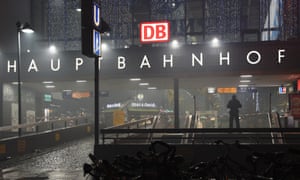
Five to seven people were reportedly planning suicide bomb attacks on the main Hauptbahnhof station and Pasing station at the western end of the city centre, in what German authorities said was a “serious, imminent threat”, prompting them to evacuate the sites and warn people to stay away.

Munich police president Hubertus Andrä told a news conference on Friday that German officials had received a “very concrete” tip that suicide attacks were planned at train stations in the southern city at midnight.
“We received names. We can’t say if they are in Munich or in fact in Germany,” Andrä said.
About 550 officers have been deployed to secure the city and no arrests had yet been made, he said.
The Bavarian interior minister, Joachim Herrmann, told a media conference on Thursday night: “The threat was very concretely centred on midnight and at these two places.” He added that all necessary security measures were being taken.
Citing anonymous security sources, Bavarian state broadcaster BR reported that Germany had received warnings from both US and French intelligence agencies earlier in the day. According to the intelligence, seven Iraqis living in Munich were named as the potential attackers, and they were planning to enter the stations in pairs and blow themselves up simultaneously.
Munich police spokeswoman Elizabeth Matzinger could not confirm the nationalities or the suspected residence of the suspects, or whether a manhunt for identified individuals was underway.

“Investigations are happening, but I cannot give out any details, that is a tactical information,” she told the Guardian. “I can’t confirm whether they are Iraqis, but it was apparently a group of five to seven people affiliated to IS [Isis].”
The two stations were shut down and evacuated around midnight, while special unit police officers armed with automatic weapons were stationed at entrances.
 Munich police issued a statement saying that an attack was expected in the city during the night, and warned people to avoid the two stations and large crowds in general. But by 4 am, the situation appeared to have calmed significantly, and the two stations were re-opened.

“The closures at the main station and the Pasing station have been lifted, but there selective controls are being carried out there,” Matzinger said. “The situation after midnight is more relaxed than it was before midnight, but notwithstanding that we cannot give the all clear. We had a terrorist warning from the French secret service and we are still taking it seriously, because we can’t rule out that it is not serious – and as long as there is still the danger of a grain of truth to it, we will continue our measures.”
At the media conference, Herrmann said the intelligence had not been 100% reliable, but serious enough that it could not be ignored.
He compared the assessment of the danger to that in Hanover on 17 November, when an international friendly football was called off and the stadium evacuated at short notice. There too, a foreign intelligence tip-off had led to the alert, but no arrests were made and no explosives found in the stadium.
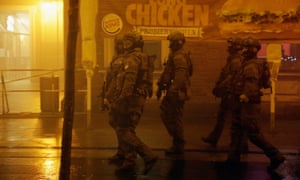
Riot police armed with machine guns patrol the streets in front of Pasing railway station in Munich on Friday.“The concrete tip-off came from one source,” Andrä said, before adding that there was no indication yet the threats could be confirmed or that any suspects had been arrested.
However, a spokesman for the police also said there would be a reinforced police presence in Munich city centre in the coming days. The police force was also bolstered in and around the Brandenburg Gate in Berlin, where huge New Year’s celebrations were being happening. All large bags and backpacks were banned from the site of the huge street party.
Despite the Munich police warnings to stay away from big crowds, thousands of people were on the streets of Munich at midnight to welcome the new year with fireworks.
DPA reported massive delays in the city’s public transportation system after both train stations were quickly evacuated and trains no longer stopped there.
The latest development comes amid ongoing security operations across Europe. Police in Belgium detained six people during house searches in Brussels on Thursday in an investigation into an alleged plot to carry out an attack in the city.
Police officers guard the entrance to the closed central station in Munich.Earlier in the week, two other people were arrested on suspicion of preparing attacks on “emblematic sites” in Brussels during the celebrations. Another man was questioned over links to last month’s Paris attacks.
Authorities in the Belgian capital said a fireworks display and festivities that attracted 100,000 people in 2014 would not go ahead after revealing the alleged jihadi plot.
“Unfortunately we have been forced to cancel the fireworks and all that was planned for tomorrow [Thursday] evening,” the mayor, Yvan Mayeur, told Belgian broadcaster RTBF. “It’s better not to take any risks.”
In Paris, where 130 people were killed in December, the annual fireworks display on the Champs Élysées was called off and 11,000 police, soldiers and firefighters patrolled the French capital. More than 100,000 police were deployed across the country, according to the interior minister, Bernard Cazeneuve.
Red Square in Moscow, traditionally a place where people gather to ring in the new year, was closed. “It’s no secret that Moscow is one of the choice targets for terrorists,” the city’s mayor, Sergei Sobyanin, said recently.
New York City said it had its tightest ever New Year’s Eve security to protect an estimated 1 million revellers.
 

Δευτέρα 21 Δεκεμβρίου 2015

Μπρουνέι: «Στοπ» στον εορτασμό των Χριστουγέννων - ποινή φυλάκισης έως και 5 χρόνια


Τα μικρό βασίλειο του Μπρουνέι αποφάσισε ότι τα χριστουγεννιάτικα δέντρα, τα κάλαντα αλλά και ο Άγιος Βασίλης, θεωρούνται πλέον ως έγκλημα. 
Το Μπρουνέι αποφάσισε όχι μόνο να απαγορεύσει δια παντός τα Χριστούγεννα αλλά και να τιμωρεί με τουλάχιστον πέντε χρόνια φυλάκιση όποιον πάει κόντρα στην συγκεκριμένη απόφαση. Το μικρό μουσουλμανικό κράτος, το οποίο διοικείται από τον Σουλτάνο Hassanal Bolkiah, αποφάσισε ότι δεν είναι σωστό για τους πιστούς του Αλάχ να γιορτάζουν τα Χριστούγεννα, και ότι αν το κάνουν θα τους επηρεάσει στην πίστη τους. 
Όσοι ωστόσο δεν είναι μουσουλμάνοι, επιτρέπεται να γιορτάσουν τα Χριστούγεννα, μόνο μέσα στις κοινότητές τους και κάτω από αυστηρά πλαίσια. Παρά το γεγονός ότι οι μουσουλμάνοι στη χώρα είναι το 65% και υπάρχουν σημαντικές κοινότητες χριστιανών και βουδιστών, η κυριαρχία των πρώτων σε όλα τα επίπεδα της εξουσίας και της κρατικής μηχανής τους καθιστά κυρίαρχους.
Παράλληλα, γίνεται ισχυρή προπαγάνδα υπέρ της θρησκείας τους, με αποτέλεσμα την απαγόρευση του εορτασμού των Χριστουγέννων, η οποία εκτός των άλλων περιλαμβάνει το στόλισμα των χριστουγεννιάτικων δέντρων σε δημόσιο χώρο, τα χριστουγεννιάτικα τραγούδια αλλά και την αποστολή χριστουγεννιάτικων ευχετήριων καρτών!
Ο Ισλαμικός Νόμος (Σαρία) στο πλούσιο από πετρέλαιο κράτος έχει αρχίσει από την Πρωτομαγιά του 2014 να εφαρμόζεται αυστηρά μετά την απόφαση του 68χρονου Σουλτάνου Hassanal Bolkiah. Ο νόμος έγινε δεκτός από τους μουσουλμάνους παρά τις αντιδράσεις (εγχώριες και μη.

Aretha Franklin is a worse person than you thought

Aretha Franklin showed little r-e-s-p-e-c-t for fellow theatergoers at a performance of “The Color Purple” last week. But when fans realized it was the Queen of Soul who was breaking the rules, they apologized to her.
According to a witness, Franklin showed up late to a performance at the Jacobs Theatre, took up six seats around her and began holding her phone in the air to snap photos of the show — and that was all before intermission!
“She arrived a few minutes late with four bodyguards. One to sit in front, one behind, and one on either side. The prime orchestra seat in front of her was empty,” entertainment writer Brandon Voss posted to Facebook friends.
Then, “During the opening number she began taking photos on her phone, lifting it high and proud, much to the murmuring disgust of those around us,” Voss reported. Then an “older white lady” in the audience began “gesturing wildly for her to put down the phone, letting her bodyguard know it wasn’t allowed.”

That’s when an usher arrived, and “It took her an eternity, but she finally shut it down.”
But at intermission, the woman who’d complained “realized it wasn’t a human being but was in fact THE Aretha Franklin, she APOLOGIZED,” Voss posted. “Because it’s Aretha f - - king Franklin, and she can take pictures whenever and wherever she wants.”
But “Then shortly before the second act starts, after being approached by many fans, she accuses me of not being in the right seat and wants to check my ticket,” Voss wrote. “She doesn’t recognize me . . . [m]aybe because I was on time? I didn’t think my mouth could open that wide.”
And “finally, after the show was over, her bodyguards asked our whole row to file out the other side because Aretha was just going to sit and chill.” But Voss figured, “I have no problem with any of this, quite frankly. #RESPECT.”
Page Six reported that after the show, Franklin met Jennifer Hudson and the cast backstage. A rep for the show said: “Aretha attended the show with a party of six . . . I don’t have any knowledge of her taking photos during the show.”

Sepp Blatter and Michel Platini Are Barred From Soccer for 8 Years


With white whiskers sprouting from his chin, a bandage across one cheek and his tie slightly askew, Sepp Blatter, the longtime president of FIFA, appeared slightly unkempt on Monday morning. When he spoke at a news conference in Zurich, however, Mr. Blatter was simply unbowed.
Ranting against his lengthy suspension from the sport by FIFA’s ethics committee — a committee he helped create and routinely endorsed — Mr. Blatter, 79, wove widely in his rhetoric, variously invoking his humanitarianism, his loyalty, his passion, his moral compass and his faith. He spoke in English, Spanish, French and German — and declared in all of them that his four-decade career should not end in disgrace.
“I want to talk about betrayal,” he said. “Today, first of all, I was very sad. But not anymore. Now I am fighting.”
 His battle figures to be especially difficult. Mr. Blatter and Michel Platini, two of the most powerful figures in global soccer, were barred from the sport for eight years on Monday after being found guilty of ethics violations.

For Mr. Blatter, who has been FIFA’s president since 1998, as well as Mr. Platini, who is the president of UEFA, which oversees soccer in Europe, the bans prohibit any involvement in soccer-related activities — a sanction that, in Mr. Platini’s case, seemingly ends any chance that he will be able to run in February’s special election to fill the post Mr. Blatter has said he will vacate.
Mr. Blatter’s suspension means that he will not be able to step away from soccer on his own terms, a reality that appeared to infuriate him.
“Of course, I should have stopped after the 2014 World Cup,” Mr. Blatter said, referencing his decision not to retire last year but instead to pursue a fifth term as president. “That would have been perhaps the wise thing to do. Now we are in a situation we don’t deserve to be in.”
Mr. Blatter and Mr. Platini, 60, had been provisionally suspended since October while the investigative chamber of the ethics committee scrutinized their actions, in particular a payment of about $2 million that Mr. Blatter approved for Mr. Platini in 2011. The judiciary chamber of the committee ruled on Monday that there was no legal basis for the payment, and it also said that both men were guilty of a conflict of interest in agreeing to it. “Neither in his written statement nor in his personal hearing was Mr. Blatter able to demonstrate another legal basis for this payment,” the committee said. “His assertion of an oral agreement was determined as not convincing and was rejected by the chamber.”

The committee said Mr. Platini’s actions “did not show commitment to an ethical attitude,” adding that he had abused his position as a vice president for the soccer body and as a member of its executive committee.
In a statement sent to the French press agency, Mr. Platini denied the charges and said the entire situation was a “true mockery.” He also labeled the disciplinary process “pathetic” and said the decision against him went against “all legitimacy and credibility.”

Mr. Blatter, who at one point questioned whether the ethics committee even had the authority to discipline the FIFA president, struck a similar tone. “I am ashamed that the committee goes against the evidence presented,” he said. “I have never cheated with money.”
Mr. Blatter, who was fined 50,000 Swiss francs, or about $50,370, and Mr. Platini, who was fined 80,000 Swiss francs, will appeal the verdicts to FIFA and then to the Court of Arbitration for Sport, which is based in Switzerland and frequently arbitrates matters involving sports governance. Both men are also likely to seek an expedited process. Mr. Blatter wants desperately to have his name cleared so that he can host the special FIFA Congress in which his successor will be chosen. Mr. Platini, who had long been seen as the front-runner in the election, will hope to salvage a last-ditch entry into the race.

At this point, however, the suspensions are likely to leave Mr. Blatter and Mr. Platini on the outside of the sport they have led for decades. The two men remain under investigation by Swiss prosecutors, and while UEFA released a statement of support for Mr. Platini, that backing was not unanimous.
“Eight years are not enough for me,” Javier Tebas, the Spanish league president, said, according to The Associated Press. “The penalty should be that they can never again form part of a sports institution.”
In his news conference, held somewhat bizarrely at FIFA’s former headquarters in Zurich, Mr. Blatter, who has worked for FIFA since 1975, was at times bold and defiant. But he also rambled frequently, stopping at one point to congratulate F.C. Barcelona on its recent victory in FIFA’s Club World Cup. At another, he lamented the effect the investigation has had on his family, telling reporters that his granddaughter recently changed schools because she had been subjected to taunting.
 Mr. Blatter declined to speak at length about his health — he was hospitalized last month for what a spokesman said was fatigue — but wore a bandage on his face after the recent removal of a mole. Sitting alongside his daughter, Corrine, Mr. Blatter described himself as a “punching ball” of world soccer.

Mr. Blatter became FIFA’s president in 1998, and Mr. Platini worked for him as a special consultant from 1999 until 2002. The $2 million payment approved by Mr. Blatter in 2011 was, he said, simply a delayed salary payment.
“Suspended eight years for what?” he said, claiming that the payment to Mr. Platini was not recorded in FIFA’s records because of an administrative error.
There was no written contract detailing the basis for the payment, however, and Mr. Platini has said in interviews that there was simply a “gentleman’s agreement” between him and Mr. Blatter to cover the deferred money.
Investigators found the late payment suspicious in part because of its timing — a few months before Mr. Blatter began campaigning for re-election to a fourth term as FIFA president. UEFA, led by Mr. Platini, supported Mr. Blatter, who subsequently won the vote after the only other candidate in the race withdrew. On Friday, Mr. Blatter denied any link between the payment and the election.

“I’m a man of principles,” he said. “I will fight for me and I will fight for FIFA.”
Amid the continuing criminal investigations of FIFA in the United States, Switzerland and other countries, FIFA’s ethics committee has been more public in its discipline recently, and Monday’s bans were not out of context with previous decisions. Chung Mong-joon, an honorary FIFA vice president, recently received a six-year ban for ethics violations, and Harold Mayne-Nicholls, a Chilean who was involved in the evaluation of the 2018 and 2022 World Cup bids, received a seven-year ban.
Now, it is Mr. Blatter and Mr. Platini who have received similar suspensions, though Mr. Blatter vowed that this would not be the end to his career in soccer. At the conclusion of his news conference, which lasted nearly and an hour, he departed with a promise.
“I’ll be back,” he said.

Σκηνικό άγριου πολέμου στο Κουρδιστάν: Οι αντάρτες αντιστέκονται στον τουρκικό στρατό

ΦΩΤΟΓΡΑΦΙΑ ΑΡΧΕΙΟΥ: Water cannons are deployed by Turkish police to disperse people during an anti-Government protest in Istanbul, Turkey.  EPA, SEDAT SUNA
Σφοδρές συγκρούσεις μεταξύ των τουρκικών ενόπλων δυνάμεων και των ανταρτών του Εργατικού Κόμματος του Κουρδιστάν (PKK) σημειώθηκαν σήμερα στη νοτιοανατολική Τουρκία, όπου ο τουρκικός στρατός διεξάγει από την περασμένη εβδομάδα τη μεγαλύτερη επιχείρησή του των τελευταίων ετών.
Αλλεπάλληλοι πυροβολισμοί που συνοδεύονταν από εκρήξεις ακούστηκαν στις πόλεις Τσιζρέ και Σιλόπη της επαρχίας Σιρνάκ, όπου έχει επιβληθεί απαγόρευση της κυκλοφορίας. Στο Τσιζρέ ένα ελικόπτερο του τουρκικού στρατού υποχρεώθηκε να προσγειωθεί καθώς μπήκε στο στόχαστρο των μαχητών του PKK, ανέφερε η εφημερίδα Hürriyet.
Σύμφωνα με τον τελευταίο απολογισμό που έδωσε σήμερα στη δημοσιότητα το γενικό επιτελείο των τουρκικών ενόπλων δυνάμεων “89 τρομοκράτες εξουδετερώθηκαν” στο Τσιζρέ, εννέα στη Σιλόπη και άλλοι επτά στο Σουρ, στην επαρχία Ντιγιάρμπακιρ αφότου ξεκίνησε η επιχείρηση. Το πρακτορείο Ανατολή μετέδωσε εξάλλου ότι δέκα μέλη του PKK σκοτώθηκαν στο Νταργκετζίτ, στη γειτονική επαρχία Μαρντίν.
Το πρακτορείο ανέφερε επίσης ότι δύο στρατιώτες σκοτώθηκαν και έξι τραυματίστηκαν από έκρηξη βόμβας κοντά στην πόλη Μπιτλίς.
Στο Νουσάιμπιν, επίσης στην επαρχία Μαρντίν, η απαγόρευση της κυκλοφορίας που είχε επιβληθεί σε τρεις συνοικίες επεκτάθηκαν σήμερα σε άλλες έντεκα.
Η σύγκρουση “έχει μπει σε μια νέα φάση”, εκτίμησε ο Μουράτ Καραγιλάν, ο ασκών την ηγεσία του PKK. “Η σύρραξη εξελίσσεται σε εμφύλιο πόλεμο”, είπε, σε συνέντευξη που παραχώρησε στΟ κουρδικό πρακτορείο ειδήσεων Firat.
Τουρκικός ισχυρισμός: Περισσότεροι από 100 Κούρδοι μαχητές σκοτώθηκαν σε μια ευρεία επιχείρηση εναντίον του PKK 

Περισσότεροι από 100 μαχητές του Εργατικού Κόμματος του Κουρδιστάν (PKK) σκοτώθηκαν τις τελευταίες πέντε ημέρες κατά τη διάρκεια μιας πρωτοφανούς σε εύρος στρατιωτικής επιχείρησης που συνεχίζεται στο νοτιοανατολικό τμήμα της Τουρκίας.
Η επιχείρηση, που πραγματοποιούν από κοινού οι ένοπλες δυνάμεις και οι ειδικές δυνάμεις της αστυνομίας, έχει στοιχίσει την ζωή σε 102 ανθρώπους στις τάξεις του PKK, σύμφωνα με έναν νέο απολογισμό που δόθηκε σήμερα στη δημοσιότητα από μια πηγή των υπηρεσιών ασφαλείας.
Επιπλέον, τουλάχιστον δύο στρατιώτες και πέντε πολίτες έχουν χάσει την ζωή τους στις συγκρούσεις, διευκρίνισε η ίδια πηγή.
Συνολικά, 10.000 άνδρες με την υποστήριξη αρμάτων μάχης έχουν κινητοποιηθεί και συμμετέχουν σε αυτήν την επιχείρηση που στοχεύει στο να εκδιώξει τους Κούρδους μαχητές από τα αστικά κέντρα, ενώ επικεντρώνεται σε δύο πόλεις κοντά στα σύνορα Συρίας και Ιράκ, το Τζιζρέ και τη Σιλόπι. Σε αυτές τις δύο περιοχές της επαρχίας Σιρνάκ έχει επιβληθεί απαγόρευση κυκλοφορίας εδώ και ημέρες.
Ένας προηγούμενος απολογισμός που ανακοίνωσε χθες ο τουρκικός στρατός έκανε λόγο για 70 Κούρδους μαχητές νεκρούς.
Ο αρχηγός του γενικού επιτελείου εθνικής άμυνας της Τουρκίας, στρατηγός Χουλουσί Ακάρ επισκέφθηκε χθες τα τουρκικά στρατεύματα στην περιοχή και ενημερώθηκε σχετικά με την πρόοδο των επιχειρήσεων.
«Οι επιχειρήσεις στην περιοχή (…) θα συνεχιστούν με αποφασιστικότητα μέχρι να αποκατασταθεί η δημόσια τάξη» επισημαίνεται σε ένα δελτίο τύπου των τουρκικών ενόπλων δυνάμεων με αφορμή την επίσκεψη Ακάρ.
ΓΑΛΛΙΚΟ ΠΡΑΚΤΟΡΕΙΟ, ΑΠΕ-ΜΠΕ, Αγκυρα-Ντιγιάρμπακιρ, Turkey

Phoenix Capital: Ο «κακός» αποπληθωρισμός… επέστρεψε – Θα οδηγήσει σε μια νέα κρίση;

Το μεγάλο «πείραμα της αναθέρμανσης της οικονομίας» έχει αποτύχει, αναφέρει χαρακτηριστικά η Phoenix Capital
Τον κώδωνα του κινδύνου κρούει η Phoenix Capital, σημειώνοντας ότι ο αποπληθωρισμός έχει επιστρέψει, την ώρα που οι κεντρικοί τραπεζίτες έχουν σαστίσει και δεν ξέρουν πώς να αντιδράσουν.
Ειδικότερα επισημαίνει πως οι κεντρικές τράπεζες έχουν μειώσει τα επιτόκια συνολικά 600 φορές από 2009 και έπειτα και έχουν τυπώσει πάνω από 15 τρισ. δολάρια, χωρίς να καταφέρουν να δημιουργήσουν την αναμενόμενη οικονομική ανάπτυξη.
Παρά την αποτυχία, τόσο η ΕΚΤ, όσο και η Τράπεζα της Ιαπωνίας διεξάγουν μεγάλα προγράμματα ποσοτικής χαλάρωσης, ενώ η Fed είναι η μόνη μεγάλη κεντρική τράπεζα που δεν αναπτύσσει με ταχύ ρυθμό τον ισολογισμό της.
«Γιατί έπειτα από έξι χρόνια οι τράπεζες εξακολουθούν τέτοιες επιθετικές πολιτικές;», διερωτάται η Phoenix Capital, απαντώντας ότι αυτές οι πολιτικές συνεχίζονται λόγω των αποπληθωριστικών τάσεων που εμμένουν.
Στη συνέχεια αναφέρει πως είναι γνωστό σε όλους ότι ο αποπληθωρισμός είναι ένα καλό πράγμα.
Ειδικότερα, σχολιάζει πως κανείς δεν θα παραπονεθεί επειδή πρέπει να πληρώσει λιγότερα χρήματα για να αγοράσει κάτι, όπως για παράδειγμα ένα σπίτι, βενζίνη ή έναν υπολογιστή.
Ωστόσο, ο αποπληθωρισμός του χρέους είναι μια διαφορετική ιστορία, επισημαίνει η Phoenix Capital.
Και αυτό διότι ο αποπληθωρισμός του χρέους μεταφράζεται σε αύξηση των μελλοντικών αποπληρωμών.
Πιο συγκεκριμένα, αυτό μεταφράζεται σε επιδείνωση της εξυπηρέτησης του χρέους, οδηγώντας τελικά σε χρεοκοπία και αναδιάρθρωσή του.
 Ο αποπληθωρισμός του χρέους είναι αυτός που παραμένει στο επίκεντρο της νομισματικής πολιτικής που ασκούν οι κεντρικές τράπεζες.
Πράγματι, αν σκεφτεί κανείς την απειλή του αποπληθωρισμού του χρέους, κάθε κίνηση των κεντρικών τραπεζών έχει νόημα, σημειώνει χαρακτηριστικά η Phoenix Capital, καθώς έχουν όλες στόχο να μειώσουν τα επιτόκια και να ωθήσουν σε άνοδο τα ομόλογα.
Με αυτό κατά νου, λέει η Phoenix Capital, ακόμα και μια οριακή επιδείνωση του αποπληθωρισμού του χρέους θα ήταν αρκετή να δώσει εφιάλτες στους κεντρικούς τραπεζίτες.
Είναι επίσης ο λόγος που εμφανίζονται λάτρεις του πληθωρισμού μέσω της υποτίμησης του νομίσματος, καθώς τους επιτρέπει να καταστήσουν πιο εξυπηρετούμενο το τεράστιο φορτίο χρέους.
Δυστυχώς, το μεγάλο «πείραμα της αναθέρμανσης της οικονομίας» έχει αποτύχει, προσθέτει χαρακτηριστικά η Phoenix Capital.
Πράγματι, όπως η Societe Generale έχει σημειώσει, φαίνεται ότιο ανεπτυγμένος κόσμος μπορεί να «μετατρέπεται σε Ιαπωνία», δηλαδή να κινείται προς ένα μακροπρόθεσμο αποπληθωριστικό κύκλο παρόμοιο με εκείνο που μαστίζει την Ιαπωνία τα τελευταία 20 χρόνια.

www.bankingnews.gr 

Dog's life saved by policeman who rescues him from raging house fire

This dramatic footage captures the moment a dog trapped by a dangerous house fire is rescued by a policeman.
As the clip starts the officer comes into view and is trying to corner the animal.
The scared pooch eventually gives in and the large mutt is scooped up in the arms of the officer.
The hazard then becomes clear as the pair race past a huge building fire.
They make it through the danger zone and out on to the road to safety.
Youtube Mexicos-police-save-dog.jpgThe clip was uploaded to Facebook and has been viewed more than 72,000 times and the officer has been praised for his actions.
Youtube Mexicos-police-save-dog.jpgLast month another pooch managed to start a house fire while looking for food.
Youtube Mexicos-police-save-dog.jpg

Behind the Black Flag: The Recruitment of an ISIS Killer

Hassan Aboud’s practiced baritone belied the malevolence in his words.
“Oh Darraji!” he sang. “Our state provided us ammunition and sent us to assassinate you.”
That state is the self-proclaimed Islamic State, also known as ISIS or ISIL, the terrorist group that controls territory in Syria and Iraq and has recently projected violence to Ankara, Beirut, Paris and San Bernardino, Calif. A soft-spoken double-amputee sometimes carried to meetings by fellow gunmen, Mr. Aboud is an Islamic State commander who also directs a network of assassins, including those who killed Darraji, a former subordinate, with bullets and flame.
The recording of his singing circulated among past associates this year. A taunting dark requiem, it serves as evidence and confession. Mr. Aboud, who defected from Syria’s rebels to the terrorist group in 2014, was admitting to previously unsolved killings of former friends.
“We plucked Adeeb Abbas’s head,” he continued, naming another of his one-time deputies, blasted from a motorcycle by a roadside bomb. “We spilled his filthy blood.”
He then vowed to kill more, as a male chorus chanted to those marked to die: “We will liquidate every traitor.”

Since rising to prominence as an international menace, the Islamic State has tried to glorify its members, describing them as religious warriors who raised arms to protect fellow Sunni Muslims and serve their understanding of God. But the journey of Mr. Aboud, and his recruitment by ISIS, including with cash, departs from scripts emphasizing piety or civil defense.
It is the chronicle of an underground fighter maimed and darkened by his long fight, the biography — replete with rivalries and fratricide — of a proven and once popular Islamist commander whose actions turned more violent and vengeful as he moved into the Islamic State’s orbit.
Mr. Aboud, his former neighbors and associates say, abandoned the defense of his hometown for money, power and the license for viciousness that came with joining the Islamic State. His path resembled not the airbrushed arcs laid out in jihadist propaganda mills but a Middle Eastern mafia tale set against the corrupting effects of war.
The journey from jihadist rank-and-file to feared underground figure was shaped by multiple forces. These include the American invasion of Iraq in 2003 and the oppression of a border-straddling Sunni Muslim population by governments in Damascus and Baghdad. It was further stoked by the indiscriminate killing of civilians by Syrian security forces since 2011, then channeled by the patient plotting of a jihadist organization, once shattered, that revived itself to eclipse Al Qaeda.
 Ultimately, his courtship by ISIS offers an unusually detailed look at how the group has selected commanders from a region that has produced uncountable militants since 2003. These chosen men, seduced by gifts and the Islamic State’s gloomy prestige, hold the terrain it needs to support its claim of being a caliphate.

Journalists for The New York Times met Mr. Aboud in Syria in 2013, as he led sieges around isolated army positions that were shelling the civilian population nearby; it was a fight he and the several hundred rebels he led, known as the Dawood Brigade, eventually won.
Sarmin, the town in the lowlands of Idlib Province where he headquartered his brigade, was itself under frequent shelling, and he was moving and accepting meetings with much more caution than many rebel commanders.
The interview was arranged by the son-in-law of his boss, but Mr. Aboud’s supporters had everyone wait in the basement of a mosque for part of the afternoon before leading the group to an abandoned building in the partially evacuated, battle-scarred town.

Mr. Aboud was rushed in from the outside by those who carried him. He had lost fighters in battle the previous day and seemed weary and suspicious of guests. His gray pants had been folded to hide his lower-leg stumps, which he crossed in front of himself as he sat on a cushion. He opened the conversation in a quiet voice, and threatened to kill the journalists if he were misquoted.
Abu Ayman, a bomb-maker who helped carry him into the room, spoke more than Mr. Aboud, who chose his words with care, even when repeating Islamist boilerplate.
He complained about the activities of many secular rebels, describing them as opportunists and profiteers. “There are Free Syrian Army brigades,” Mr. Aboud said, that get weapons and “sell them in trade.” He asserted, again speaking softly, that Syria was being plunged into sectarian war by Iran and those it underwrites, including the Syrian government and Hezbollah. “Iran is seeking to re-establish the Persian empire, to get control over the whole Middle East,” he said.
Immediately after the conversation, he was picked up, carried swiftly outside and set on the front passenger seat of a muddy S.U.V., which sped away.
The Times returned to the Turkish-Syrian border after his defection and vendetta killings to interview those who worked with him closely.

Today Mr. Aboud, in his mid-30s, is an exile from Sarmin, where he had lived most of his adult life. Past associates refer to him as either an ISIS wali or emir, titles conveying authority or military power that the Islamic State bestows on governors and its middle rank.
They note that he did not simply drift to ISIS; he has had a relationship with the original underground Sunni insurgents in Iraq’s Anbar Province, part of the crucible where ISIS formed, reaching back more than a decade.
Mr. Aboud and one of his brothers fought American forces there in 2004 and 2005, several townspeople said. Some suggested that the pair returned to Syria as a sleeper cell tied to Al Qaeda in Iraq, which was founded by Abu Musab al-Zarqawi and after his death in 2006 eventually became ISIS.
In the nearly year and a half since Mr. Aboud publicly joined the Islamic State, taking with him most of his fighters and many powerful weapons, he has been credited with, or blamed for, a sprawling mix of battlefield action and crime. Those who know him contend he led the capture of Palmyra, the town and ancient heritage site that ISIS defiled.
For all of Mr. Aboud’s activity, however, his story suggests limits to advancement within the group, which analysts say to a large degree remains led by Iraqis, including many connected to the dismantled Baathist regime of Saddam Hussein.
 Hassan al-Dugheim, a rebel cleric who said he had observed Mr. Aboud since 2011, said his tactical skill and ruthlessness were beyond question. He bluntly added, however, that he considered Mr. Aboud stupid, and that the Islamic State had found in him a man who could be flattered, bought, then used.

“Syrians are for fighting,” he said, and those who had joined ISIS recently faced a glass ceiling inside. “They are like animals to be ridden, like a horse or a mule.”

Crucible of Sunni Militancy

Photo
Hassan Aboud was among the earliest of his townspeople to experience war on what would become the Islamic State’s turf.
In 2004, he and a brother, known as Abu Shadi, traveled to Iraq to join the fight against the American military around Falluja and Ramadi, according to residents of Sarmin. Mr. Aboud, a stoneworker, was in his 20s, entering freshly colonized turf in a militant underworld.
Accounts of his Iraq time vary. Some confusion, his townspeople say, is because Mr. Aboud was circumspect about his activities — an unsurprising behavior considering concerns in Syria’s Alawite-led government that those aligned with Sunni militants in Iraq could rekindle unrest in the Sunni population at home.
Mr. Aboud’s associates said he returned in 2005. A relative, who asked for anonymity so as not to draw his wrath, said that while away Mr. Aboud swore allegiance, or bayat, to his militant leaders. “It was known Hassan Aboud was Al Qaeda,” he said.

Another man, an activist from Sarmin who worked with the Dawood Brigade, said he had seen a video from 2005 of Mr. Aboud with Mr. Zarqawi.
A proponent of terrorism, deliberate savagery and management by fear, Mr. Zarqawi helped push Iraq into sectarian war, inspired a generation of jihadists and became one of the world’s most wanted men before American bombs killed him in 2006. His group later rebuffed top Qaeda leaders to form ISIS.
Mr. Dugheim, the cleric, said he doubted Mr. Aboud was a Qaeda member, noting that he concerned himself solely with local battles and was opposed to the Nusra Front, Syria’s official Qaeda franchise, as it gathered strength. “I exclude the possibility that he really gave bayat,” he said.
Others noted, however, that the Nusra Front and the Islamic State were competitors who became foes, and Mr. Aboud’s connections were not with the central Qaeda leadership that gave the Nusra Front its jihadist authority but with the Iraq wing. Opposition to the Nusra Front, by this view, did not exclude allegiance to the faction that became ISIS.
Photo
Whatever the inner loyalties, Mr. Aboud’s life as a fighter once appeared to end. His return home was noteworthy. The activist who worked with him said he knew five men from Sarmin who fought in Iraq. Two died as suicide bombers.
Mr. Aboud dodged that fate, and resumed an unassuming life: He owned a Kia truck and earned wages delivering cement and rebar.
By 2007 he and his brothers owned a workshop, made cinder blocks, sold decorative and patio stone and hired out for contracts. “I used to see him at a lot of houses under construction, and he had laborers working for him, five or six at a time,” the activist said.

Roughly two years before the uprising, Syrian security forces raided Sarmin, cracking down on Sunni networks. One of Mr. Aboud’s brothers was caught.
“Abu Shadi was detained in the street, and taken to Sednaya prison,” the activist said, referring to the infamous jail near Damascus where the government warehoused those it considered Sunni extremists.
In the interview with The Times in 2013, Mr. Aboud confirmed the arrest, but gave a minimal explanation, suggesting his brother had been punished for his faith. “My brother was sent to jail because of his beard,” he said.
He described Syria’s government as an oppressive weight. “They can fight you for an idea you carry in your mind, because of your beard, the way you pray or you dress,” he said. “It is like a siege on your emotions and your beliefs.”
Mr. Aboud seemed to elude the attention of intelligence services. Neighbors said he was conservative and religious, but not overtly so. He wore a beard, but kept it trimmed. Sometimes he smoked, although descriptions of him tend to center on his clean living.
He and his wife were raising a family. His night life consisted of staying up late, drinking tea. “He had a good reputation, nothing bad,” said a doctor in Sarmin who said he often met Mr. Aboud, but asked not to be named for his safety.

Return to War

In early 2011, after popular uprisings in Tunisia, Egypt and Libya, protests erupted in Syria against President Bashar al-Assad. Mr. Aboud went underground, beginning his long campaign.
“When it started in Tunisia, we were optimistic,” he told The Times. “We started to arrange and coordinate with people we trusted.”
The government fired on protesters in Dara’a that March, killing at least three. Mr. Aboud said bloodshed triggered action. “A day later we joined the revolution, beginning with demonstrations out of the mosques,” he said.
Syria was on a path to war. Mr. Aboud’s former allies recall his clear sense of the steps to take at each stage — skills they suspect he learned in Iraq.
Protest organizers left their homes to sleep in fields and among the trees, dodging security forces. Sarmin’s quiet stoneworker, they learned, was more ready than most. “Hassan Aboud would bring us bread and canned food,” said Ahmed al-Aasi, an activist with Ahrar al-Sham, a large Islamist fighting group.
He was quick to violence. As Syria deployed its army, Mr. Aboud was among the first armed rebels in a landscape that would eventually be awash in them.

In June 2011, while Syrian protesters appealed for international support, Mr. Aboud participated in the ambush of an army convoy near Jisr al-Shoughour, four associates said. The little band in which he fought with a friend, Dawood al-Sheikh, had only seven or eight rifles.
It was a quixotic clash. Mr. Sheikh was killed. The road remained open. Crackdowns continued apace. It also provided a glimpse of the future: Mr. Aboud soon formed a fighting group, named it the Dawood Brigade and left protests behind.

His brigade started small. But it set up a guerrilla base among olive groves and caves, where it trained, manufactured weapons and extended its fight. By late 2011, it joined Suqour al-Sham, or Sham Falcons brigade, an Islamist group founded by Ahmed Abu Issa, a former prisoner in Sednaya.
Many early rebel groups lacked experience, money, training and cohesion. The Dawood Brigade was different, Mr. Aboud’s townspeople said. It tended to details necessary to become a fighting force.
Mr. Aboud’s brother, released from Sednaya, organized logistics, including medical care and convalescence in Turkey for wounded fighters. Mr. Aboud established training regimens that even his critics say produced results.
“Hassan Aboud has a mean heart, and he is fierce, and he tells his fighters to be hard and fierce in battle,” said the activist who used to work with him. “No other group in Idlib had this ferocity, and he made them like this because of his training.”
“They had constant and continuous training,” the doctor said, in tactics, weapons and sports.
Mr. Aboud gained access to funders from the Persian Gulf, and more support from Abu Issa. “Sham Falcons gave them a big share of the money and resources because they had results,” said Abu Ameen, another activist who worked with rebel commanders.

In 2012, the brigade had drawn in hundreds of local men, amassed weapons and paid salaries of $140 a month. “This was at a time when other rebel groups could not offer their fighters lunch,” said another activist, Mohyeddin Abdulrazzaq, who otherwise spoke harshly of Mr. Aboud.
The brigade also mastered a staple of militant war: the use of improvised bombs, with which it punished Syrian forces and controlled roads. “They had sophisticated bombing operations in the beginning, when no one else did it,” Abu Ameen said.
Other rebel units caught up to this tactic, and together shifted the nature of the war, forcing the Syrian Army to withdraw to outposts and bases.
One result was the creation of marginally governed territory into which foreign fighters flowed, and where ISIS would eventually assert a place. In the short term, Mr. Aboud achieved a degree of local popularity. “Hassan Aboud was sacred among his fighters,” Mr. Abdulrazzaq said. “When you mouthed bad words among his fighters, it was as if you mouthed bad words against God.”

As Mr. Aboud gained power his activities sometimes turned sinister. Mr. Aasi said he became involved in the abductions of Alawites, and sought ransoms for their release. Other rebel leaders once intervened to stop the Dawood Brigade from executing civilians near Fuoa, a government-controlled town, Mr. Aasi said; among the detainees were women and a child. “He had a criminal tendency,” he said. “He became a dictator even before we had an ISIS.”
His affinity for irregular war almost led to his death.
From its bases, the army increased the shelling of Sunni towns, setting in motion waves of refugees. The brigade’s arms-makers started producing rockets, which they fired at the soldiers concentrated at government positions. “We targeted their camps with lots of rockets,” Mr. Aboud told The Times in 2013. “It was good, accepted.”
In late 2012, the brigade was filming a video for a Qatari funder, an activist said, when a rocket exploded prematurely, gravely wounding several rebels, including Mr. Aboud, whose lower legs were mangled.

Mr. Aboud survived the ride to a clinic, where both his feet were amputated. The doctor recalled being surprised by his demeanor. “For someone who had just had his feet removed, he had high morale,” he said. “He was joking.”
When Mr. Aboud was interviewed months later by The Times, he mentioned the mishap only when asked. “One time we were launching a rocket and it exploded and that’s how I lost my legs,” he said, and changed the subject. “Now we have improved rockets,” he added. “More safe. More effective. Bigger.”

Frustration and Recruitment

By 2013 the Dawood Brigade had established more bases, expanded training, participated in prominent battles and captured many more weapons. By some counts Mr. Aboud possessed nine tanks, four B.M.P. fighting vehicles and a fleet of trucks carrying 14.5-millimeter machine guns.
A tactical powerhouse, he was in demand on Arabic-language news stations. With rebel prestige came rivalries, the office politics of war. Mr. Aboud, those who know him said, believed his successes had not been adequately rewarded or gained him autonomy.

“Dawood Brigade is the one who participated in the battles and made the gains, but all the support and money went to Abu Issa and the Sham Falcons,” his relative said.
Mr. Dugheim said that in 2013, as Islamist rebel groups discussed merging into a united front, Mr. Aboud wanted equal billing with the Falcons. Abu Issa rejected the proposal. Mr. Aboud seethed.
Distance from rebel leadership grew. “His funds went down with the loss of support, and he was in trouble,” Mr. Dugheim said.
It was then that ISIS made its move. A shadowy presence compared to now, it sought to lure him into its ranks.
People who know Mr. Aboud describe a series of meetings with Islamic State leaders from Iraq, including with Abu Ali al-Anbari, a former Iraqi military officer who moved outside the city of Aleppo with a security contingent and a mission to recruit local commanders.
Abu Ameen described a “secret operational phase” by ISIS in 2013 that targeted rebel and activist networks. Its timing aligned with Mr. Aboud’s disputes, he said, “and Dawood Brigade is one of the groups that was infiltrated.”

At one point, activists said, Abu Ali called a meeting of rebel leaders in Idlib Province to discuss relationships with ISIS. He also sent ISIS agents to Sarmin to woo Mr. Aboud, who had begun to noticeably fall under the Islamic State’s sway.
Mr. Dugheim said he mediated between Abu Issa and Mr. Aboud at the time. ISIS, he said, was flattering the brigade with attention and gifts.
“ISIS offered Hassan Aboud a big amount of money — $2 million — when Hassan Aboud actually had nothing in hand,” Mr. Dugheim said. “They gave him weapons and money and food.”
This sum could not be independently confirmed.
 Abu Ameen said Abu Ali’s calculated strategy won over many fighters. “Some joined ISIS publicly, but some joined ISIS but remained within the same group they were part of,” he said. “With money and promises, ISIS got control of hearts and minds.”

Even before the public defection, hints of extremist influence appeared in his brigade.
Through 2013, associates said, the brigade had not been linked to suicide bombings. Mr. Aboud, they said, did not use his fighters, mostly local men, that way.
But a video of brigade training, posted online in October 2013, shows recruits being lectured in suicide tactics by a middle-aged man with closely cropped hair and a long beard. The Dawood logo is superimposed on the scene.
An American military official who analyzes ISIS said the recruitment and changes fit a pattern. “It was a successful intelligence operation,” she said. “They were able to go in, find people who were vulnerable and could be flipped, flip them, and turn it into what they perceive as a state.”
Mr. Dugheim said by then Mr. Aboud parroted the Islamic State’s style, sometimes behaving like a takfiri, one who labels other Muslims as insufficiently religious, and thus impure.

The change in persona, Mr. Dugheim said, indicated a man out of his depth. “One of the problems in human nature is when you have a hero who is stupid,” he said. “And Hassan Aboud is a hero who is stupid.”
“He misread the situation,” he added.
Photo

Defection and Fratricide

The killings began before the Dawood Brigade drove out of Sarmin. Mr. Aboud was turning on his own.
Among the first victims were Darraji and Bassim Abdulrazzaq, brothers who had joined the brigade in 2012.
The pair had formed a smaller rebel group that occasionally collaborated with its old boss. In December 2013, they joined the brigade in a battle against a Syrian checkpoint, according to Mohyeddin Abdulrazzaq, a second cousin of the men.
The checkpoint fell. But one brother was wounded, several fighters were killed and a heavy machine gun they relied on was destroyed. Shaken, they asked Mr. Aboud for a 14.5-millimeter machine gun to cover their loss. He refused.
In January 2014, Mohyeddin Abdulrazzaq said, the brothers asked again. They visited Mr. Aboud, were cheered when he consented and drove off with their new weapon. They did not make it far.
“A few hours later came news to the town of a vehicle burned on the road,” he said. “It held Darraji and his brother. Aboud gave them the machine gun, and then had them killed.”
It was not just that Mr. Aboud did not like being asked twice. Darraji had publicly spoken against ISIS in the fall, when it had kidnapped workers from the International Committee of the Red Cross near Sarmin.

Mr. Aboud appeared for the funeral and paid respects.
Not long after, Mr. Aboud announced he was joining a new group, Jaish al-Sham. Throughout early 2014 the group seemed a symbol of infighting and dysfunction, repeatedly clashing with other rebels. Mr. Aboud’s associates said that sometimes he expressed allegiance to the Islamic State, and that other times he renounced it.
Abu Ameen said, in hindsight, that Mr. Aboud was following new masters. “Getting instructions from ISIS,” he said.

Residents said they suspected Mr. Aboud of organizing hits, including on a Dawood commander, nicknamed Hyena, and Abu Abbas, the brigade’s Shariah instructor. But there was no clear proof, and the brigade’s brooding presence created disincentives to inquiry.
Mr. Aboud’s affiliation finally became explicit in July, when he formed his brigade into a convoy, ostensibly bound for Aleppo and yet another fight. “Only those close to him knew the real plan,” his relative said.
Short of Aleppo, Mr. Aboud stopped and announced that he was a servant of Abu Bakr al-Baghdadi, the Islamic State’s leader, and was heading to Raqqa, its operational hub, to join the caliphate.
“Hassan told them that he had given bayat to Abu Bakr, and those who wanted to stay with him could stay and those who wanted to go were free,” the activist who worked with him said.
How many members were present is a matter of dispute. Several former associates said a few hundred. (News reports claimed as many as 1,000; an exaggeration, residents of Sarmin say.)
About 100 fighters declined, and returned home with the news.
The brigade’s departure deepened the troubles of an already beleaguered town. Its defenses were weakened, residents said, because Mr. Aboud took a large fraction of the area’s weapons, forsaking those he had vowed to protect.

Behind the Black Banner

Since Mr. Aboud arrived in Raqqa, his associates said, they have had only occasional insight into his militant life. ISIS, they note, is a such a closed system that little is known even of Mr. Baghdadi and the nature of his power. Mr. Aboud and his brigade, once he defected, dialed back their social media presence and interviews. His activities, they said, have been assembled piecemeal.
Mr. Dugheim was among the last to speak with him before his defection. ISIS had just swept across part of Iraq, capturing Mosul and Tikrit. Mr. Aboud appeared smitten, as if it were 2004 again.
“I said to him, ‘Why do you like ISIS?’” Mr. Dugheim said. The reply had little to do with Syria’s revolution: “Because ISIS is being fought by the U.S.A.”
The American military analyst said that today Mr. Aboud appeared to be “of midlevel stature,” and that “ISIL-core will exploit his quote-unquote ‘talents’” while seeing him as “disposable, expendable.”
This matched what his townspeople described — the Dawood Brigade’s movement across the Islamic State’s Syrian territory on a range of shifting missions. Based on where his fighters have been killed, they said, Mr. Aboud has fought in Kobani, Aleppo, near Raqqa, near Homs and for the Shaer gas field and the capture of Palmyra.

The brigade has also been accused, without public evidence, of assassinating the leadership of Ahrar al-Sham, and of holding the abducted journalist James Foley before turning him over to ISIS. (ISIS beheaded Mr. Foley in 2014. Claims of a Dawood Brigade role in his detention, made in news reports and echoed on social media, do not align with facts known of his case.)
Photo
One sighting of Mr. Aboud occurred in June in Palmyra. Khaled al-Homsi, an activist, said he was briefly imprisoned there, and Mr. Aboud toured the jail on crutches. “He met me privately in a room,” he said, “to convince me to pledge allegiance.”
After the Islamic State consolidated control in Palmyra, he added, some of the staff in the courts were from the Dawood Brigade, suggesting Mr. Aboud was trying to govern.

Efforts to reach Mr. Aboud this fall were unsuccessful. But former associates said they expected he would fail at such aspirations.
Mr. Aasi said Mr. Aboud’s role was obvious — as an enforcer, an instrument of purposeful violence to help ISIS gain territory and rule by fear. “With ISIS there are no limits, and you can abduct and kill whomever you like,” he said. “Hassan Aboud does not have a problem with killing. He likes it.”
The rebels’ former ally, he said, “is sick in his mind.”
Mr. Dugheim, the cleric, said Mr. Aboud left Sham Falcons for an even more complicated game, and had peaked. “Regardless of his title, he cannot make a decision,” he said, because ISIS limits the authority of its Syrian commanders.
Another American military official who analyzes ISIS said that under the pressure of airstrikes and internal strife, members with titles like emir and wali now gain rank through attrition, not design. “We watch the deck shuffle constantly, as they attempt to determine who will fit a role that has been vacated,” he said, “vacated” being a euphemism for “killed.”
Whatever Mr. Aboud’s eventual fate, his relative said, much of the legacy was already known. The recording of Mr. Aboud singing — coolly in tune as he described killing old friends — was a marker of a man lost to crime, a revolution soured and a people betrayed.
 “His violence, his assassinations, his killing people — he is really behind this,” he said. “It is a mess now. Everything we have is a mess.”
Spanish election: national newcomers end era of two-party dominance

Spanish politicians are gearing up for what could be weeks of complicated negotiations after the general election resulted in a deeply fragmented parliament, with the conservative People’s party losing ground to national newcomers Podemos and Ciudadanos.
The PP won 123 seats in Sunday’s election, with 29% of the vote, leaving it far from a majority in the 350-seat legislature. Led by Mariano Rajoy, the current prime minister, the party has limited possibilities when it comes to the alliances it now needs to form a stable government majority.
The Socialists, who asserted their place as the traditional rival of the conservatives throughout the campaign, came second, with 90 seats and 22% of the vote. With many in Spain still suffering the lingering effects of an economic crisis that sent unemployment rates soaring and triggered painful austerity measures, millions of voters turned away from the PP and Socialists, who have alternated in power for decades, and instead looked to emerging parties.
 Anti-austerity Podemos, barely two years old and born from the Indignado protests that saw thousands rally against a political establishment felt to be out of sync with the people, finished in third place with 69 seats and 21% of the vote, while the centre-right Ciudadanos won 40 seats and 14% of the vote. “Spain is not going to be the same anymore and we are very happy,” the Podemos leader, Pablo Iglesias, said on Sunday. “The bipartisan political system is over.” The PP and Socialists won a combined vote share of about 50%, compared with the 70-80% of past general elections.

Podemos did remarkably well across the country, coming first in Catalonia – where it ran in a coalition with Barcelona en Comú – and the Basque country, a result that suggested widespread support for its campaign promise to hold a referendum on Catalan independence. “Today is a historic day for Spain,” Iglesias told supporters on Sunday night. “Every time there is an election, the forces of change advance.”
Ciudadanos, launched in 2006 as a regional party to counter Catalan separatism and which expanded nationally last year, also celebrated its result on Sunday. “Today begins a new phase of hope and excitement,” said its leader, Albert Rivera. “Millions in Spain have decided that things are going to change.”
The results leave open the possibility for Rajoy to become one of the first leaders in Europe to be re-elected after imposing harsh austerity measures, but he faces a tremendous uphill battle to take power. “I’m going to try and form a government,” Rajoy told cheering supporters on Sunday as the results came in. “But it won’t be easy.”

In order to be able to govern for the next four years, the PP will have to rely on other parties, suggesting that a protracted process of negotiations lies ahead for Spain’s political leaders.
Several scenarios are possible. In the run-up to the election, many analysts had predicted that the new government would be made up of the PP and supported in some way by Ciudadanos. But now the two parties together are still short of a majority.
Any such alliance would require a third partner, a scenario that shifts some of the balance of power to regional parties from Catalonia and the Basque country and will be complicated by both parties’ vehement opposition to Catalan independence and Ciudadanos’ insistence on eradicating longstanding Basque tax benefits.

If the PP can manage to find enough support or abstentions to survive a vote of confidence, the conservatives could attempt to rule with a minority government. The option is fraught with instability, as the party will be forced to negotiate demands, ranging from constitutional reform to a referendum in Catalonia, that run counter to their electoral platform.
Many analysts pointed to a pact between the PP and Socialists – a move roundly rejected by the Socialist party on Monday, who said it would vote against having acting Prime Minister Mariano Rajoy form a new government. Such a pact would have been unprecedented for Spain and likely crippled the Socialists’ prospects in future elections.
 Another alternative, echoing developments in Portugal, would be a coalition of the Socialists, Podemos and Ciudadanos. However, Rivera said this week his party would not support what he called a “grouping of losers”, diminishing the likelihood of this option. Such a coalition would clash over issues such as Catalan independence – with Ciudadanos opposed to any talk of a referendum and Podemos promising it would allow Catalans a vote on the issue – and contradict Podemos’ promises to do away with the regime that has governed Spain since the return to democracy.

Sunday’s results could allow the Socialists to govern with the support of Podemos and several smaller parties, such as the Republican Left of Catalonia, which won nine seats, or Artur Mas’s Convergence party, which won eight.
If the Socialists are able to amass enough votes to gain control of the lower house of parliament, their government’s attempts to push forward initiatives such as constitutional reform would likely be quashed by the country’s senate, where the election left the PP with an absolute majority.
On Sunday evening the Socialist leader, Pedro Sánchez, congratulated Rajoy and said he would allow the conservative leader to take the first crack at forming a government: “It’s up to the first place political force to try and form a government.” But he noted that the election results had ushered in a new chapter of Spanish politics, saying: “We’re beginning a new process of dialogue and agreement.”

The election results will prompt what could be months of negotiations, said Pablo Simón, a political science professor at Madrid’s Carlos III University. “They need to talk, they need to negotiate. Anything is possible.” He pointed to the 1996 election, won by the PP and resulting in a government propped up by Catalan and Basque nationalists. “The first time PP came into power, it took two months to reach an agreement.”
Despite a result that ranks as their worst in the party’s modern history, the Socialists are now key to the question of what comes next, said Emilio Sáenz-Francés, a professor of history and international relations at Madrid’s Comillas Pontifical University. “The question is whether Sánchez will allow Rajoy to lead the government or whether Sánchez will try to build a coalition of several parties in order to take power,” said Sáenz-Francés.
He pointed to Spain’s King Felipe VI, who by mid-January will have to name the party that will have the chance to try and form a government. The candidate must then obtain an absolute majority in a vote of confidence and if they fail to do so, a simple majority vote will be held 48 hours later. If the candidate again fails to win the vote, the king must put forward a new candidate. If no government is formed within two months, new elections must be held.
 Most likely the king will give Rajoy and the PP the first chance to form a government, given that it won the election, said Sáenz-Francés. “But for the first time in the history of democracy in Spain, it’s not clear how the most-voted party will be able to govern.”

Πέμπτη 17 Δεκεμβρίου 2015

Navy SEALs, a Beating Death and Claims of a Cover-Up

The three Navy SEALs stomped on the bound Afghan detainees and dropped heavy stones on their chests, the witnesses recalled. They stood on the prisoners’ heads and poured bottles of water on some of their faces in what, to a pair of Army soldiers, appeared to be an improvised form of waterboarding.
A few hours earlier, shortly after dawn on May 31, 2012, a bomb had exploded at a checkpoint manned by an Afghan Local Police unit that the SEALs were training. Angered by the death of one of their comrades in the blast, the police militiamen had rounded up half a dozen or more suspects from a market in the village of Kalach and forced them to a nearby American outpost. Along the way, they beat them with rifle butts and car antennas.
A United States Army medic standing guard at the base, Specialist David Walker, had expected the men from SEAL Team 2 to put a stop to the abuse. Instead, he said, one of them “jump-kicked this guy kneeling on the ground.” Two others joined in, Specialist Walker and several other soldiers recounted, and along with the Afghan militiamen, they beat the detainees so badly that by dusk, one would die.
The four American soldiers working with the SEALs reported the episode, which has not previously been disclosed. In a Navy criminal investigation, two Navy support personnel said they had witnessed some abuse by the SEALs, as did a local police officer. Separately, an Afghan detained with the man who died provided a detailed account of mistreatment by American troops and Afghan militiamen in an interview with The New York Times.

The SEAL command, though, cleared the Team 2 members of wrongdoing in a closed disciplinary process that is typically used only for minor infractions, disregarding a Navy lawyer’s recommendation that the troops face assault charges and choosing not to seek a court-martial. Two of the SEALs and their lieutenant have since been promoted, even though their commander in Afghanistan recommended that they be forced out of the elite SEAL teams.
“It just comes down to what’s wrong and what’s right,” Specialist Walker said in a recent interview. “You can’t squint hard enough to make this gray.”
Even before the beatings, some of the SEALs had exhibited troubling behavior. According to the soldiers and Afghan villagers, they had amused themselves by tossing grenades over the walls of their base, firing high-caliber weapons at passing vehicles and even aiming slingshots at children, striking them in the face with hard candy.
Abuse of detainees is among the most serious offenses an American service member can commit. Several military justice experts, who reviewed a Naval Criminal Investigative Service report on the case at the request of The Times, said that it had been inappropriate for the SEAL command to treat such allegations as an internal disciplinary matter and that it should have referred the case for an Article 32 review, the equivalent of a grand jury, to consider a court-martial.

“It’s unfathomable,” said Donald J. Guter, a retired rear admiral and former judge advocate general of the Navy, in charge of all its lawyers. “It really does look like this was intended just to bury this.”
Photo
Navy officials defended the handling of the case, saying the SEAL captain who oversaw it had had full authority to decide it as he saw fit. The captain, Robert E. Smith, who was then in charge of SEALs based on the East Coast and is now a military assistant to the secretary of the Navy, said in a recent statement that the Team 2 members had denied abusing the detainees.
Captain Smith said that he had found inconsistencies in the soldiers’ accounts when they were questioned five months later, and that conflicting statements from the Army and Navy witnesses “did not give me enough confidence in their overall accuracy to hold the accused accountable for assaults or abuse, or warrant Article 32 proceedings.”
While he said it was “evident” that the Afghan militiamen had mistreated the detainees and that the SEALs had not reported it, he dismissed charges for failing to make such a report.
What happened in Kalach involved just one death in a conflict that has taken thousands of lives, but it had broader consequences. Instead of winning over the local population, the goal of the mission, the reported abuse further alienated villagers. It drove some previously cooperative Afghans to leave for Taliban-controlled areas, residents said.

The SEALs’ failure to restrain the Afghan Local Police, who were supposed to protect villages but instead often terrorized them, helped erode confidence in the American and Afghan governments, whose forces have repeatedly been accused of abusing or killing civilians.
During the United States’ engagement in Afghanistan, now stretching into its 15th year, the American military has expanded the mandate for SEALs, sometimes assigning them roles for which they are neither suited nor trained.
Brushing away serious charges, military justice experts said, reflects a breakdown of accountability that feeds the perception that SEALs and other elite Special Operations units get undue leeway when it comes to discipline. In murky wars with unclear battle lines, they warned, that can corrode ethical clarity and undermine morale.
“What’s the message for the 10,000 guys that were in the same moment and said, ‘No, we’re not crossing this line’?” asked Geoffrey S. Corn, a former military lawyer who was the Army’s senior expert adviser on the law of war. “It diminishes the immense courage it takes to maintain that line between legitimate and illegitimate violence.”

This account of the events at Kalach, in southern Afghanistan’s Oruzgan Province, and how the Navy handled them is based on interviews with dozens of current and former military personnel. Reporters located victims and other villagers in Afghanistan and tracked down the four American soldiers who made the abuse allegations, who are now scattered across the United States. Most were initially reluctant to speak.
Continue reading the main story

A Guide to the N.C.I.S. Investigative Report

A review of the documents provides vivid details of the detainee abuse reported at a military outpost at Kalach, Afghanistan.
The Times also obtained the report prepared by the Naval Criminal Investigative Service, including sworn statements by Army, Navy and Afghan witnesses. All names were redacted in the document, acquired through the Freedom of Information Act, but several people familiar with the investigation confirmed them. The report was reviewed by four former military lawyers and a civilian military law expert.
In addition to describing misconduct by the SEALs, villagers complained that the Americans had empowered the local militia to act with impunity — taking goods from shops in the market, ransacking homes and delivering a rifle butt to the belly of those who resisted them.
The Afghan militiamen in Kalach “were like dogs, and the Americans were the masters,” said Hajji Ahmad Khan Muslim Gizabe, a prominent elder there. “The masters would follow behind the dogs, telling them what to do.”
Mr. Gizabe said that he had been among the Afghans who aided Hamid Karzai, the future president, in 2001 when he was flown into Oruzgan with American forces to foment resistance to the Taliban. But after what happened in 2012, he said, “I cannot support the Americans.”

Everything Changed

The small base at Kalach was just a speck in Afghanistan’s rugged terrain, dwarfed by the mountains behind it. The stone wall surrounding the outpost was barely chest-high, offering little protection from a Taliban attack. The objective was to get Americans close to the people they were training, instead of living behind high blast walls and shiny razor wire like most of the troops in the United States-led coalition in Afghanistan.
Continue reading the main story
The outpost was set up by Green Berets, the Army Special Forces troops who recruited the Afghan Local Police. The militia program had become a crucial element of the American strategy to win over villagers and undercut the Taliban. The emphasis on counterinsurgency, as the strategy was known, aligned with the skills of the Green Berets, who were trained to wage guerrilla campaigns by working with irregular militias and supporting local communities.
The Navy’s nine SEAL teams, in contrast, typically conduct capture-and-kill missions and train militaries and counterterrorism forces in other countries. In a place like Kalach, “you need a combination of T.E. Lawrence, John Rambo and the Verizon guy,” said Scott Mann, a former Green Beret who helped design what were known as village stability operations in Afghanistan. “There’s a lot of the Special Ops community that would much rather shoot somebody in the face than do this kind of work.”
Kalach lies in a belt of territory in Oruzgan Province that separates Afghanistan’s central highlands — dominated by members of the Hazara ethnic group, Shiite Muslims who were brutally repressed under Taliban rule — from the southern heartland of the Pashtuns, the predominantly Sunni Muslim ethnic group from which the Taliban draws almost all its support. The groups live separately in Kalach, a village of several thousand people, and the volunteers for the militia were all Hazara, a problem the Green Berets were eager to fix.

“The villagers asked me to talk to the Americans,” said Hajji Muhammadzai, a Pashtun mullah. The Green Berets promised to build schools, roads, bridges and a clinic in return for help recruiting local police officers, Mullah Muhammadzai recalled. Even though the Green Berets found no takers among the Pashtuns, the soldiers addressed the elders with respect, drank tea with them and tried to sway them through persuasion rather than threats, he said in an interview.
An infantry squad that included Specialist Walker, the Army medic, arrived at the outpost shortly before Christmas in 2011. With broad shoulders and blond hair — his nickname was Thor — Specialist Walker could not have looked more foreign to Afghans. But he forged a relationship with the father of a boy whom he was treating for leukemia, and the man continued to drop by the clinic after his son’s death, sometimes passing on information such as when Taliban spotters were watching the outpost. The soldiers also got to know the militiamen, teaching them how to use their weapons and repel the Taliban. There were shared feasts, even a snowball fight.
But the Green Berets rotated out in early 2012 and were replaced by a detachment from SEAL Team 2, whose men had been deployed to Iraq and Afghanistan over the years for operations targeting militants. Other members of the team were scattered across villages beyond Kalach.
Photo
 
 
“We had to fill so many emerging requirements with units that weren’t necessarily as prepared as they could have been,” said Mr. Mann, the former Green Beret. “There’s a whole mind-set and training curriculum that goes with Green Berets that’s radically different from Navy SEALs.”
The change in tone was soon apparent. Staff Sgt. David Roschak, the Army squad leader at Kalach, said the new arrivals assumed “anyone near the base was, or linked to, the Taliban.” Some of the Team 2 members saw their job as killing enemies, not making friends, he and other soldiers said in interviews.
Several seemed absorbed with the SEALs’ growing celebrity, the soldiers said: They talked about the SEAL Team 6 raid that killed Osama bin Laden, and debated whether to write books like “Lone Survivor,” the account of a SEAL who survived a disastrous mission in 2005. One night, some of them insisted that the soldiers watch a movie, “Act of Valor,” that starred active-duty SEALs.
Serious discipline issues emerged, according to the soldiers. Apparently bored by the routine of life on the small outpost, several of the SEALs began using their weapons for sport. One shot his pistol wildly at a kitten under the ammunition shed, the soldiers said; anyone at the small base, then full of people, could have been hit by a ricochet. Another pulled a handgun on a soldier in the base gym, apparently as a joke.

“They were very sloppy, very boisterous: ‘We’re here to destroy everything,’ ” Specialist Walker said. In a situation with “a gun battle every day, that’s perfect,” he continued. But “we’re here to train people, assist, not there to gag ’em and bag ’em.”
Afghans described in interviews how the new group of Americans would shoot at the ground around farmers in wheat fields and almond groves near the base, or on the road to the market. A few times, they shot at trucks moving along a ridgeline. “They weren’t trying to kill anyone,” Mr. Gizabe, the Kalach elder, said. “They were toying with them, I think.”
The tenor of the meetings between the Americans and the elders changed, too, villagers said. The SEALs often shouted at the Afghans; when they disagreed, several elders recounted in interviews, the SEALs sometimes grabbed them by their shirts, lifted them off the ground and cocked their arms back as if preparing to hit them. “Each and every time we went to their base, we feared we would not come back out,” Mullah Muhammadzai said.

According to Specialist Walker, one Team 2 member grew annoyed with the repeated visits of the man whose child had died of leukemia. Specialist Walker found the father one day with two missing teeth, a scraped lip and a contusion that ran from under his left eye down to his jaw. The man, he said, told him that the American had punched him in the face.

Rounding Up Suspects

The explosion at the checkpoint in May 2012 kicked a cloud of dust high into the sky. Afghan militia members jumped on their motorcycles and rode down to investigate, soon returning to the base with their fallen comrade in the back of a truck.
Their search for suspects led them to a trio of itinerant scrap merchants and some villagers who had contact with them. The three men, Pashtuns who had been in town for little more than a week, eked out their living collecting junk: old car parts, empty oil drums, aluminum cans. One of the three, Assadullah, 25 — who, like many Afghans, goes by only one name — said they had risen before dawn to secure the cargo in their three-wheel motorized rickshaw and had been eating bread and drinking tea before the bomb exploded.
The police officers entered the room in a market stall where the men were staying and began bludgeoning them — Mr. Assadullah; Muhammad Hashem, about 24; and Faisal Rehmat, about 25 — with their rifle butts. “They just started hitting us,” Mr. Assadullah recalled in an interview, “on our shoulders, on our backs, everywhere.
 
They bound the men’s hands with their traditional wool scarves and marched them to the outpost more than a kilometer away. “Along the road, they were beating us with stones and rifles,” Mr. Assadullah said. He added that he had seen other Afghan civilians at the base but that they had been kept separate during questioning.
The mistreatment was hardly unique for some of the police militias. From the outset of the program, the Americans running it found that some officers used their newfound power to engage in everything from petty theft and bullying to extortion rackets and killings.
An American military report released in December 2011 found that local police militias were illegally taxing villagers and committing assaults, yet also concluded that the militias were effective.